Antisemitism and the persecution of Jews
Doctor ZhivagoAntisemitism and the persecution of Jews are rendered as both a public violence and a moral contradiction: an elderly man is humiliated in a village crowd, while the larger wartime burden borne by Jews prompts Yurii Zhivago and Misha Gordon to debate nationhood, Christianity, and the meaning of individual life. The scene makes persecution tangible, then refuses to leave it as an isolated spectacle: it becomes the occasion for a dispute over why hatred persists and what kind of community might overcome it.
The village humiliation
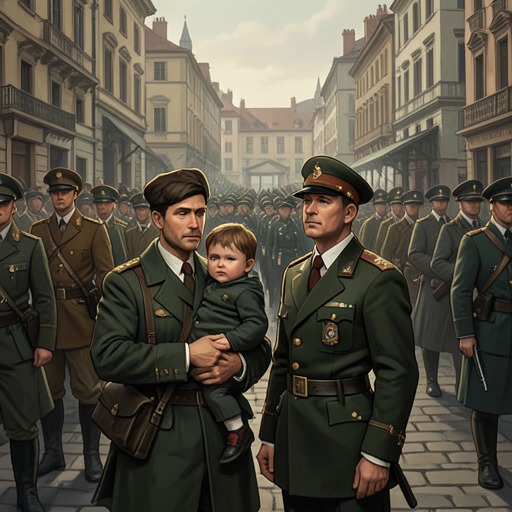
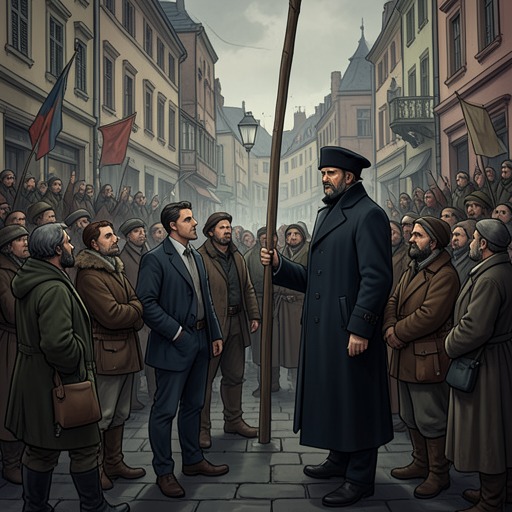
The villages in the war zone have been miraculously spared the surrounding destruction, forming an intact island amid ruins. Yet preservation of buildings and streets does not mean safety for their Jewish inhabitants. One evening, as Gordon and Zhivago travel home at sunset, they see a young Cossack in a village making an old Jewish man catch a copper coin tossed into the air. The man misses, the coin falls into the mud, and when he bends to retrieve it the Cossack slaps him. A crowd laughs at the spectacle.
The humiliation has an audience beyond the laughing men. The old man’s wife repeatedly runs from the house across the road, screaming and reaching toward him, then retreats in terror. Two little girls watch their grandfather from a window and cry. The driver slows down because he finds the scene amusing and wants the passengers to enjoy it; Zhivago instead calls out to the Cossack, rebukes him, and orders him to stop. The Cossack readily claims that no harm was intended and that it was only a joke. The difference between the claimed harmlessness and the frightened family’s response gives the episode its moral force: the crowd’s amusement depends on making a vulnerable man the object of public degradation, while the possibility of more serious violence remains unresolved.
From incident to wartime pattern
After the encounter, Gordon and Zhivago drive on in silence. When they come within sight of their own village, Zhivago says the Jewish population is suffering terribly because the war is taking place in the Pale. He names more than the taunting they have just witnessed: punitive taxation, destruction of property, pogroms, insults, and accusations that Jews lack patriotism. His question is pointed: under enemy rule, Jews enjoy equal rights, while those who claim to defend them persecute them. In his view, the hatred is irrational, stimulated not by strength or threat but by the very conditions that ought to invite sympathy—their poverty, overcrowding, weakness, and inability to fight back. He describes this recurrence as resembling an inescapable fate rather than offering a tidy explanation for it.
Gordon does not answer at once. Later, he returns to the episode in conversation with Zhivago. He calls the Cossack’s torment of the old man an ignominy and argues that such an immediate act calls for action rather than abstract reflection. The particular cruelty and the broader Jewish question, however, demand different responses: one requires someone to intervene; the other leads him into philosophical argument. The sequence holds those responses together without confusing them. Thought cannot substitute for stopping an assault, but the assault also exposes a social pattern that a single rebuke cannot end.
Gordon’s Christian argument
Gordon’s account of the persecution turns on a distinction between national loyalty and the transformation of nations through Christianity. He asks what makes a person serve a nation: noisy declarations, or actions whose beauty and greatness raise that nation to universality and give it lasting renown. In the Christian era, he argues, nations are not simply unchanged inheritances; they are transformed communities. The Gospel, in his reading, does not merely repeat an older assurance that all people are equal before God. Its more radical proposal is a new way of living and a new society born from the heart, in which there are no nations, only individuals.
This claim also develops a point about facts and meaning. Gordon recalls the idea that facts do not become meaningful by accumulating them; human beings must put something of their own into them. He identifies Christianity’s mystery of the individual as the meaning to be brought to the facts. The scene of humiliation thus stands against the abstract habits of public discussion: naming suffering is not enough if the suffering person remains a specimen of a national question rather than a distinct human being. Gordon’s language makes the individual central, even as his argument risks treating the collective identity of the persecuted as something that should simply be relinquished.
The contradiction of identity and release
Gordon sees the Jews as the sharpest example of the intellectual habit by which publicists and self-appointed friends of the people turn a small, suffering nation into a subject for displays of cleverness and compassion. He describes Jewish national identity as a historical burden that has kept Jews bound to being a nation, while the rest of the world has supposedly been released from that condition by a new force arising among the Jews themselves. The paradox is severe: the Christian transformation Gordon celebrates began in Jewish land, was proclaimed in a Jewish language, and belonged to the Jewish people, yet he imagines that the community has remained an empty husk of a miracle it rejected.
From that paradox he asks why innocent old men, women, and children should be mocked and beaten across the centuries, and why the intellectual leaders of the Jewish people have not called for the abandonment of a bounded identity and dispersal among others. His argument condemns persecution, but it also presses an assimilationist demand: in the name of Christian universality, he asks the persecuted to stop holding to their identity. The tension matters. The old man’s beating cannot be excused by any theory of national separation, yet Gordon’s proposed answer risks making the victims’ continued distinctness part of the problem. The novel gives the argument force as an expression of moral outrage without dissolving that contradiction.
Recurrence across private and public life
The persecution of Jews belongs to a novel that repeatedly shifts between public upheaval and intimate experience. Zhivago writes to his wife amid the disintegration and anarchy of the army, reporting his rounds among nearby units and mentioning his work with a Moscow nurse. Elsewhere, amid the bureaucratic forms and statistics of revolutionary life, he writes a private journal about people ceasing to be themselves and acting unknown parts. These contexts do not erase the particular danger seen in the village; they place it within a wider world where institutions classify people, political loyalties harden, and ordinary life is repeatedly disrupted.
The novel also returns to the idea of history as a process whose change is difficult to see while it is happening. Zhivago compares social history to a forest’s hidden growth: apparently still, yet ceaselessly changing. Against that slow, almost invisible movement, the village episode is abrupt and legible—a coin, a fall into the mud, a slap, a family watching in fear. Its clarity is precisely what makes the larger pattern harder to accept as fate. The scene does not offer a resolution to antisemitism; it preserves the collision between a concrete act that can be opposed and a historical hatred that Zhivago cannot explain, while Gordon’s universal ideal both challenges national exclusion and exposes the cost of asking the persecuted to transcend it.